
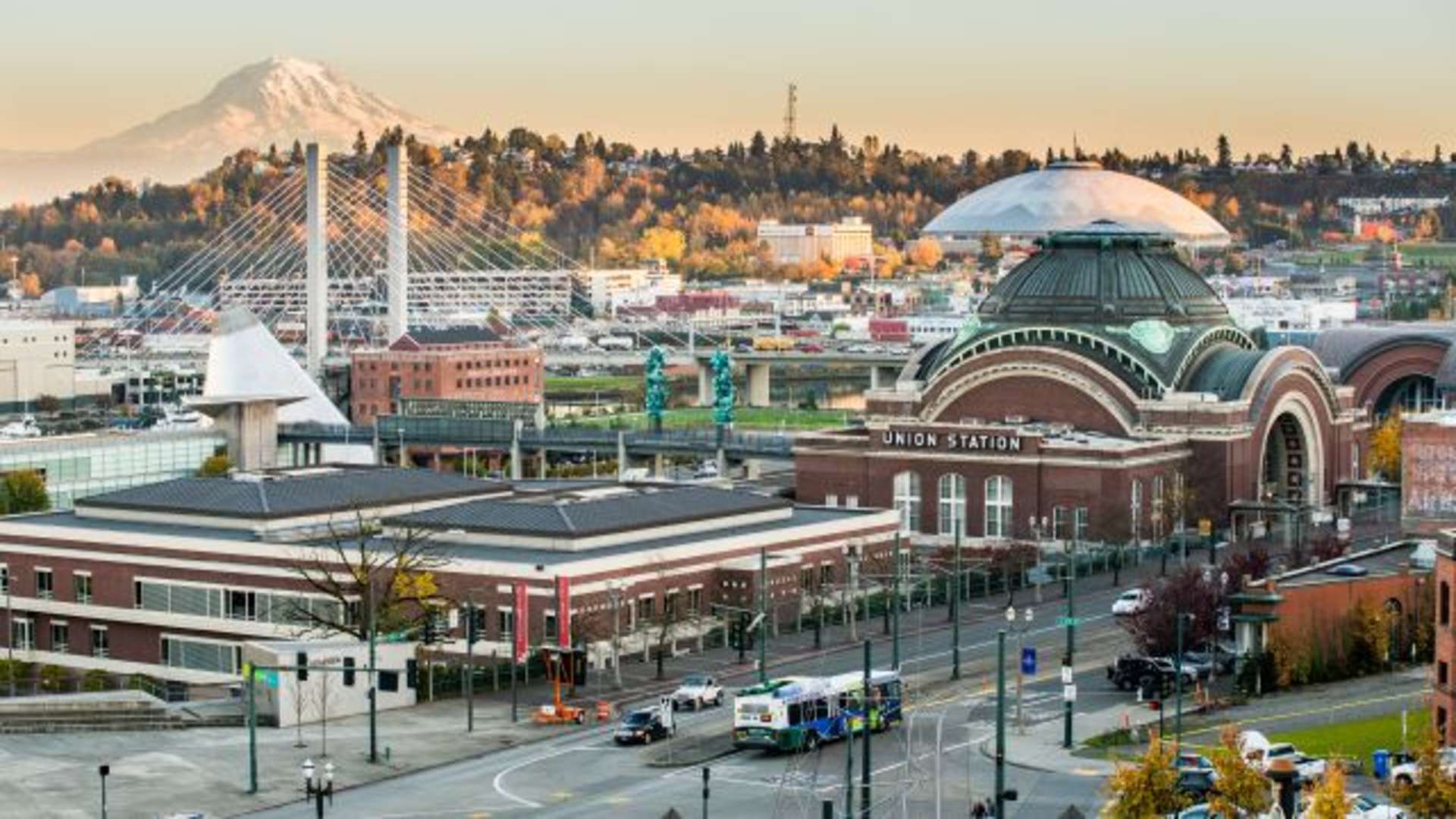
As one of the more accessible Northwest cities via rail, Tacoma, Washington, benefits from having a direct route into the Pacific Northwest via the Puget Sound corridor. From coastal cities like Seattle and Portland to as far as the East Coast in NYC and the Midwest in Chicago, every major city on the continent has a train route bringing you here, with better views and less stress than flying and with less travel time than the congestion on the roads. Here is a breakdown of the major trains to Tacoma with route, rider cost, and reservation, and what you can expect when you arrive at the Tacoma Dome Station.
Why Take a Train to Tacoma? Top Reasons to Choose Rail Travel
If you’re deciding between a flight, a road trip, or a train to reach Tacoma, rail travel has a few genuine advantages that are easy to overlook until you’ve tried it.
- Scenery you simply can’t get from a plane or highway. The Amtrak Cascades and Coast Starlight routes run along the Puget Sound shoreline, past Mount Rainier views, the Tacoma Narrows, and the Nisqually Delta. You get window-seat access to some of the best coastal and mountain views in Washington State.
- Downtown-to-downtown convenience. Tacoma Dome Station sits close to downtown Tacoma, the Tacoma Dome arena, and the Museum of Glass. There’s no long shuttle ride from an outlying airport – you arrive close to where you actually want to be.
- No TSA lines, no baggage fees on most fares. Amtrak’s boarding process is far more relaxed than airport security. Checked baggage is often included, and you can bring more with you than most airlines allow.
- Comfortable seating and room to move. Coach seats on Amtrak trains recline further and offer more legroom than economy airline seats. You can walk to a café car, stretch your legs, or work at a table seat.
- A more sustainable way to travel. Rail travel generally produces a smaller carbon footprint per passenger than flying or solo driving, which matters if you’re trying to reduce your travel emissions.
- Connects seamlessly to local transit. Tacoma Dome Station is a genuine multimodal hub – Amtrak, Sounder commuter rail, Tacoma Link light rail, and regional buses all meet at one location, so getting around after you arrive is simple.
- Family-friendly travel. Kids can move around, use the restroom without waiting for a seatbelt sign to turn off, and there’s far more room for strollers, car seats, and extra bags than on a plane or in most sedans.
- Fewer cancellations tied to weather. While delays do happen, trains are generally less prone to the kind of full-day cancellations that flights face during storms, since rail lines aren’t grounded the way aircraft are.
Note: For short regional hops (Seattle to Tacoma, Portland to Tacoma) and for scenic long-distance trips alike, rail travel to Tacoma is worth serious consideration over driving or flying.
Which Trains Go to Tacoma? Major Rail Services Explained
Tacoma is served by a mix of long-distance, regional, and commuter rail services. Here’s a breakdown of what actually runs through Tacoma Dome Station.
| Service | Operator | Type | Route Coverage |
| Amtrak Cascades | Amtrak / WSDOT / ODOT | Regional corridor | Vancouver, BC – Bellingham – Seattle – Tacoma – Portland – Eugene |
| Coast Starlight | Amtrak | Long-distance | Seattle – Tacoma – Portland – Sacramento – Bay Area – Los Angeles |
| Empire Builder (connecting) | Amtrak | Long-distance | Chicago – Spokane – Seattle (transfer to Cascades for Tacoma) |
| Sounder S Line | Sound Transit | Commuter rail | Seattle – Tacoma (weekday peak-hour service) |
| Tacoma Link (T Line) | Sound Transit | Light rail | Local Tacoma routes connecting to Tacoma Dome Station |
- For people traveling from out of the area to Tacoma, there are two important Amtrak trains, the Cascades and the Starlight. The Cascades go through the Pacific Northwest on the I-5 and are one of Amtrak’s regional workhorse trains. Starlight is a train Amtrak designed for people to take and enjoy the scenery. For people from Chicago or New York, you would likely take a long-distance train like the Empire Builder to get to Seattle, and connect to Tacoma from there.
- For people planning a trip in the near future, Amtrak Cascades service between Seattle and Portland has been disrupted as a result of a warehouse fire near Portland, where some of the trains have been replaced with a bus service, and others with a train service on a detour. The Coast Starlight will continue to run as indicated. Always check the live service alerts on Amtrak, as the schedules for this service have been very erratic.
Popular Train Routes to Tacoma From Major US Cities
Here are the most common paths to Tacoma with travel time estimates. As Tacoma lacks direct long-distance routes from the majority of cities, most of these routes require a change in Seattle, Portland, or Chicago.
| From City | Route Used | Approx. Duration | Connection Needed? |
| Seattle, WA | Amtrak Cascades or Coast Starlight | 35-45 minutes | No – direct |
| Portland, OR | Amtrak Cascades or Coast Starlight | 2.5-3 hours | No – direct |
| Vancouver, BC | Amtrak Cascades | 4.5-5 hours | No – direct |
| Eugene, OR | Amtrak Cascades | 5-6 hours | No – direct |
| Los Angeles, CA | Coast Starlight | 34-36 hours | No – direct (overnight) |
| Sacramento, CA | Coast Starlight | 22-24 hours | No – direct |
| Chicago, IL | Empire Builder to Seattle, then Cascades | 46-48 hours total | Yes – transfer in Seattle |
| New York, NY | Lake Shore Limited + Empire Builder + Cascades | 55-60+ hours total | Yes – two transfers |
| Spokane, WA | Empire Builder to Seattle, then Cascades | 9-10 hours total | Yes – transfer in Seattle |
| Chicago (via Portland) | Empire Builder to Portland, then Cascades | 48-50 hours total | Yes – transfer in Portland |
Note: From West Coast and Pacific Northwest Cities, Tacoma is more accessible, as both Seattle and Portland have lots of direct trains. Travelers from the Midwest and East Coast can anticipate a multi-day rail adventure, as connections through the Empire Builder or Lake Shore Limited long-distance trains will be necessary.
NYC to Tacoma Train: Schedule, Duration & Ticket Tips
Traveling from New York City to Tacoma by train is one of the longest domestic rail journeys in the country, and it’s not for someone in a hurry – but it’s a genuine bucket-list trip for rail enthusiasts.
The typical routing is:
- Lake Shore Limited from New York Penn Station (or Moynihan Train Hall) to Chicago Union Station – roughly 19-20 hours.
- Empire Builder from Chicago to Seattle King Street Station – roughly 45-46 hours, covering over 2,200 miles through Wisconsin, Minnesota, North Dakota, Montana, and Washington.
- Amtrak Cascades from Seattle to Tacoma Dome Station – a short 35-45 minute regional hop.
Note: Altogether, the full NYC-to-Tacoma journey runs somewhere in the range of 55 to 62 hours, depending on connection wait times in Chicago and Seattle. That’s two to three full days of travel, so most riders treat it as a scenic cross-country adventure rather than a point-to-point commute.
Ticket tips for this route:
- Book connections as a single itinerary when possible. Booking the Lake Shore Limited and Empire Builder together through Amtrak’s site can help protect your connection if the first train runs late – Amtrak’s guaranteed-connection policy typically rebooks you (and covers a hotel if needed) if a delay causes a missed transfer.
- Consider a sleeper car for the long-distance legs. A Roomette on the Empire Builder includes meals and a bed, which makes the 45-hour Chicago-to-Seattle stretch far more manageable than coach seating.
- Budget extra buffer time in Chicago. Layovers here can be tight, and delays on the Lake Shore Limited are common enough that a same-day connection isn’t guaranteed to go smoothly.
- Book several weeks ahead for sleeper availability. Roomettes and bedrooms on long-distance trains sell out well before coach seats do, especially in summer.
- Factor in the short final connection. The Seattle-to-Tacoma leg on Amtrak Cascades is inexpensive and runs multiple times daily, so it’s the easiest part of the whole trip to rebook if your earlier trains run behind schedule.
Tacoma Train Travel Tips for First-Time Passengers
If this is your first time riding Amtrak into Tacoma, a few practical pointers will make the experience smoother.
- Arrive at least 30-45 minutes early for regional trains like the Cascades, and closer to an hour early for long-distance trains like the Coast Starlight, especially if you’re checking baggage.
- Print or download your ticket to your phone – Amtrak accepts mobile tickets, and conductors scan them directly from the Amtrak app.
- Pack layers. Puget Sound weather shifts quickly, and train cars can run cool, especially near the doors.
- Bring your own snacks for regional trips – café car offerings on the Cascades are limited compared to long-distance trains, which have full dining or café cars.
- Reserve seats in advance during peak season (summer weekends, holidays) since popular departures can sell out.
- Know your baggage allowance. Amtrak generally allows two free carry-on bags and two free checked bags on routes with checked baggage service; oversized items may cost extra.
- Use the Tacoma Dome Station T Line connection if your final destination is downtown Tacoma – it’s a quick, inexpensive way to avoid a taxi or rideshare.
- Sign up for Amtrak Guest Rewards before you book – even one-time riders can bank points toward future free travel.
- Keep essentials in your carry-on, not your checked bag – chargers, medication, and a light jacket should stay within reach, especially on longer Coast Starlight segments.
- Download offline maps of Tacoma before you arrive, since cell coverage can dip briefly in tunnel sections along the route.
- Ask the conductor if you’re unsure of your stop. Regional trains move quickly between closely spaced stations, and conductors are usually happy to give you a heads-up before your station approaches.
Direct and Connecting Train Routes to Tacoma
Not every route to Tacoma requires a transfer, but many do, especially from outside the Pacific Northwest. Here’s how to tell which kind of trip you’re booking.
Direct routes to Tacoma
- Seattle to Tacoma (Cascades or Coast Starlight)
- Portland to Tacoma (Cascades or Coast Starlight)
- Vancouver, BC to Tacoma (Cascades)
- Eugene to Tacoma (Cascades)
- Los Angeles to Tacoma (Coast Starlight, overnight)
- Any station along the Cascades corridor between Vancouver, BC and Eugene, OR
Connecting routes to Tacoma
- Chicago to Tacoma (Empire Builder to Seattle or Portland, then Cascades)
- New York to Tacoma (Lake Shore Limited, then Empire Builder, then Cascades)
- Any city not directly on the Cascades or Coast Starlight corridor – you’ll typically connect through Seattle or Portland
Note: Try to schedule same-station transfers when booking connecting itineraries. Cascades trains connect with long-distance trains at both King Street Station (Seattle) and Union Station (Portland). The distance between the platforms of both stations is short. Allow for at least 45 to 60 minutes of layover time for connecting trains. Allow for extended layover time for the first time moving around a new station.
Business Class vs Coach on Tacoma Trains
On the Amtrak Cascades route (the main service most travelers use to reach Tacoma), you’ll typically choose between Coach and Business Class. Here’s how they compare.
| Feature | Coach Class | Business Class |
| Seat width & recline | Standard recline, 2×2 configuration | Wider seats, extra recline |
| Legroom | Good, but standard | More generous legroom |
| Priority boarding | No | Yes |
| Complimentary snacks/drinks | No (café car available) | Yes, often included |
| Power outlets | Available | Available, sometimes at every seat |
| Quiet car option | Sometimes available | Often included |
| Price premium over Coach | Base fare | Roughly 30-60% more, varies by route/date |
| Best for | Short regional hops, budget travelers | Business travelers, those wanting extra comfort |
Note: For trips as short as Seattle to Tacoma or Portland to Tacoma, Coach class is good and is the cheapest way to go. But for longer Cascades segments like Tacoma to Vancouver, BC or Eugene to Tacoma, Business Class is worth the upgrade for the extra comfort with a quieter cabin, plus free refreshments. For the Coast Starlight, the comparable upgrade isn’t Business Class, but rather the Roomette or Bedroom sleeper cars, since that train is meant for long-distance, overnight travel.
Tacoma Train Station: Everything You Need to Know About Tacoma Dome Station
Tacoma Dome Station is the main rail and transit hub serving Tacoma, and it’s a genuinely well-designed multimodal facility.
- Address: 424 E 25th Street, Tacoma, WA (with the Amtrak/Sounder platform building historically referenced near Puyallup Avenue in the Dome District).
- Location: Set inside the historic Freighthouse Square building in Tacoma’s Dome District, right next to the Tacoma Dome arena.
- Services at the station: Amtrak Cascades and Coast Starlight trains, Sound Transit Sounder commuter rail, Tacoma Link (T Line) light rail, and multiple Pierce Transit and Sound Transit Express bus routes.
- Station design: A roughly 10,000-square-foot terminal with glass walls, wood columns, terrazzo flooring, and a tile art installation depicting Tacoma’s railroad history.
- Parking: A large parking garage complex with over 2,000 spaces serves the station, along with additional surface parking – helpful if you’re driving in and taking the train onward.
- Accessibility: The station is fully accessible, with elevators, ramps, and ADA-compliant restrooms and platforms.
- Nearby attractions: Freighthouse Square’s shops, galleries, and restaurants are connected directly via an arcade, and downtown Tacoma, the Tacoma Dome, and the Foss Waterway are all a short ride or walk away.
- Bike facilities: Racks and lockers are available for cyclists connecting to and from the station.
Note: Because Tacoma Dome Station combines Amtrak, commuter rail, light rail, and bus service in one hub, it’s genuinely easy to arrive by train and continue your trip without needing a car or rideshare.
How to Book Train Tickets to Tacoma: Step-by-Step Guide
Booking a train to Tacoma is straightforward whether you use Amtrak’s website, app, or phone line. Here’s the process.
- Go to Amtrak.com or open the Amtrak app. Both let you search routes, compare fares, and book instantly.
- Enter Tacoma, WA (station code TAC) as your destination, along with your departure city and travel dates.
- Compare available trains. For most Tacoma-bound trips, you’ll see Cascades and Coast Starlight departures with listed times and fare classes.
- Choose your fare type. Amtrak typically offers Saver, Value, and Flexible fares (plus Business Class and sleeper options on eligible trains), each with different change and refund rules.
- Select your class of service – Coach, Business Class, or a sleeper accommodation for long-distance legs.
- Add any connections manually if booking a multi-leg trip (e.g., Empire Builder to Seattle, then Cascades to Tacoma) – Amtrak’s search tool will often suggest connecting itineraries automatically.
- Enter passenger details and any discounts you qualify for (senior, military, student, AAA, or Amtrak Guest Rewards points).
- Review baggage and seating preferences, then complete payment.
- Save your mobile ticket in the Amtrak app or print your confirmation for boarding.
- Set up trip alerts through the Amtrak app so you get real-time updates on delays or platform changes before you travel.
Note: Booking 2-4 weeks in advance generally gets you the best fare selection, though last-minute regional trips (like Seattle to Tacoma) are usually easy to book even a day or two out.
Tacoma Train Ticket Price: How Much Does It Cost & How to Save Money
Ticket prices to Tacoma vary a lot depending on distance, how far ahead you book, and which class of service you choose. Here’s a general sense of what to expect.
| Route | Typical Coach Fare Range | Typical Business/Sleeper Range |
| Seattle to Tacoma | 10-25 | 20-40 (Business Class) |
| Portland to Tacoma | 30-55 | 50-90 (Business Class) |
| Vancouver, BC to Tacoma | 45-75 | 70-120 (Business Class) |
| Eugene to Tacoma | 40-70 | 65-110 (Business Class) |
| Los Angeles to Tacoma (Coast Starlight) | 130-220 | 400-900+ (Roomette/Bedroom) |
| Chicago to Tacoma (via Seattle) | 180-300 | 600-1,200+ (Roomette/Bedroom) |
| New York to Tacoma (via Chicago & Seattle) | 250-400 | 900-1,800+ (Roomette/Bedroom) |
Note: Fares fluctuate constantly based on demand, so treat these as a planning range rather than fixed prices – always check Amtrak.com for current fares on your specific dates.
Ways to save money on Tacoma train tickets:
- Book Saver fares early. These are Amtrak’s cheapest fare tier but come with limited availability and stricter change rules.
- Travel midweek. Tuesday and Wednesday departures are often cheaper than Friday or Sunday trains.
- Use Amtrak Guest Rewards points if you travel by rail regularly – points can offset future ticket costs.
- Check for AAA, student, senior, veteran, or group discounts, which Amtrak applies automatically when eligible.
- Book connecting long-distance trips well in advance, since sleeper accommodations on the Empire Builder and Coast Starlight get more expensive (and sell out) as departure dates approach.
- Watch for seasonal promotions, which Amtrak periodically runs on Pacific Northwest routes.
- Consider a rail pass if you’re planning multiple trips around the Pacific Northwest within a set time window – it can be more economical than booking each leg separately.
Best Time to Visit Tacoma by Train: Seasonal Travel Tips
The best time to take the train to Tacoma really depends on what you want out of the trip – scenery, lower fares, or fewer crowds.
- Summer (June-August): This is peak season for Pacific Northwest rail travel. Days are long, skies are clearer for mountain and Puget Sound views, and Tacoma’s outdoor attractions (Point Defiance Park, the waterfront) are at their best. Expect higher fares and the need to book further ahead, especially for the Coast Starlight and sleeper cars.
- Fall (September-October): A great sweet spot – fewer crowds, often lower fares, and still-pleasant weather. Foliage along the Cascades route and around Mount Rainier can be a scenic bonus.
- Winter (November-February): The cheapest and quietest time to ride, but also the rainiest, and mountain-adjacent segments can occasionally see weather-related delays. Pack for rain and expect shorter daylight hours for scenic viewing.
- Spring (March-May): A shoulder season with moderate fares and fewer weather disruptions than winter, plus blooming scenery as the region turns green again. It’s a solid choice if you want decent views without summer pricing.
Note: If scenery is your top priority, aim for late spring through early fall. If saving money matters most, winter weekday travel (excluding major holidays) tends to offer the best fares and most seat availability.
Train vs Bus vs Car to Tacoma: Which Is the Best Way to Travel?
Each mode of transport to Tacoma has trade-offs. Here’s an honest comparison.
| Factor | Train | Bus | Car |
| Comfort | High – reclining seats, room to move | Moderate – fixed seating, less legroom | Depends on driver/passenger fatigue |
| Scenery | Excellent, especially Cascades/Coast Starlight | Limited, highway views only | Good if you can enjoy the drive |
| Cost | Moderate, varies by distance and class | Usually cheapest option | Variable – gas, tolls, parking, wear-and-tear |
| Speed (short regional trips) | Fast and direct | Similar or slightly slower | Fast, but subject to traffic |
| Speed (long-distance trips) | Slower than flying, faster than driving cross-country | Slower than train for long distances | Slowest for cross-country trips |
| Flexibility | Fixed schedule, but frequent regional departures | Fixed schedule, sometimes limited frequency | Total flexibility, your own timeline |
| Downtown access | Excellent – Tacoma Dome Station is central | Good – most stations are central | Depends on parking availability |
| Stress level | Low | Low to moderate | Higher, especially in traffic or bad weather |
| Environmental impact | Lower per passenger | Lower per passenger | Higher, especially solo driving |
Note: For travel to local destinations (Seattle-Tacoma, Portland-Tacoma), the train is a great choice because it’s quick, efficient, and convenient. You arrive in the city center and avoid the I-5 and traffic. For travelers who prioritize budget and time, the bus may be a better option. Travel by car is also an option for greater flexibility. You will likely spend more time in traffic, but you have a Sightseer Lounge car.
Frequently Asked Questions
1. What Amtrak trains stop in Tacoma?
Tacoma Dome Station is served by the Amtrak Cascades (Vancouver, BC to Eugene, OR) and the Coast Starlight (Seattle to Los Angeles), plus Sound Transit’s Sounder commuter rail and Tacoma Link light rail.
2. Where is the Tacoma train station located?
Tacoma Dome Station is located at 424 E 25th Street in Tacoma’s Dome District, inside the historic Freighthouse Square building, next to the Tacoma Dome arena.
3. Is there a direct train from Seattle to Tacoma?
Yes. Both the Amtrak Cascades and Coast Starlight run direct between Seattle’s King Street Station and Tacoma Dome Station, with a travel time of roughly 35-45 minutes.
4. How long does it take to get from Portland to Tacoma by train?
The trip typically takes about 2.5 to 3 hours on either the Amtrak Cascades or Coast Starlight, depending on the specific train and any stops along the way.
5. Can I take a direct train from New York to Tacoma?
No direct train exists. You’ll connect through the Lake Shore Limited to Chicago, then the Empire Builder to Seattle, and finally the Amtrak Cascades into Tacoma – a multi-day journey of roughly 55-62 hours total.
6. How much does a train ticket to Tacoma cost?
Prices vary widely by distance and class. A Seattle-to-Tacoma ticket might run 10-25, while a cross-country trip from New York can range from $250 in coach to well over $1,000 for a sleeper accommodation.
7. Does Tacoma Dome Station have parking?
Yes. The station has a large parking garage complex with over 2,000 spaces, plus additional surface parking options nearby.
8. What’s the difference between Amtrak Cascades and Coast Starlight?
The Cascades is a shorter regional service connecting Pacific Northwest cities along the I-5 corridor with frequent daily departures, while the Coast Starlight is a long-distance overnight train running the full West Coast between Seattle and Los Angeles, with sleeper car options.
9. Is Business Class worth it on the way to Tacoma?
For short regional hops like Seattle to Tacoma, Coach is fine. For longer Cascades segments or when you want extra comfort and complimentary refreshments, Business Class is a reasonable upgrade, typically 30-60% more than Coach fare.
10. What’s the best time of year to take the train to Tacoma?
Late spring through early fall offers the best scenery and weather, while winter weekdays typically offer the lowest fares and quietest trains, aside from an increased chance of weather-related delays.