
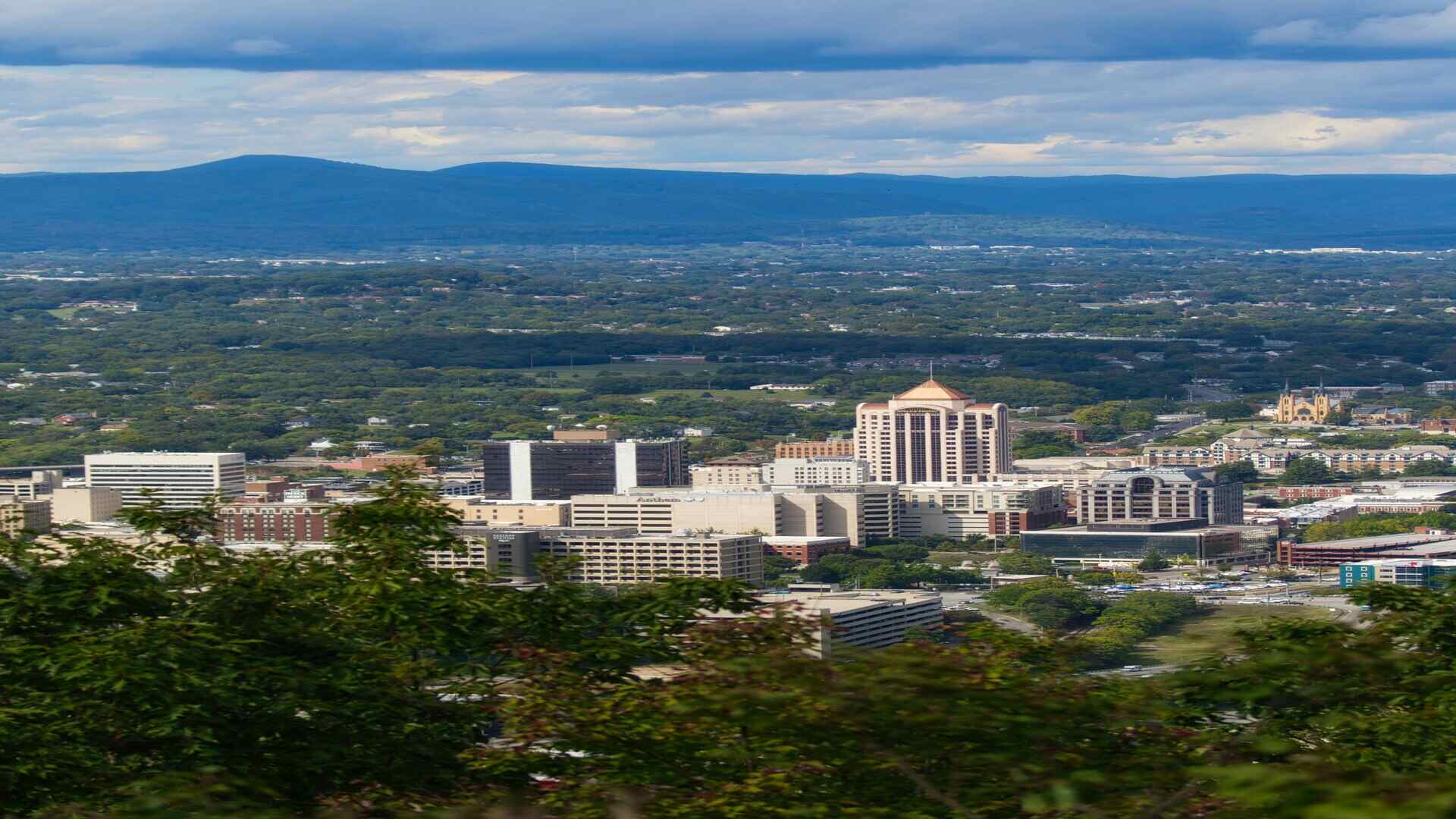
Roanoke, Virginia, located in the scenic Blue Ridge Mountain range, lies at the center of one of the most easily accessible rail destinations in the Mid-Atlantic since Amtrak expanded service to the city in 2017. Rail travel from New York City, Washington, D.C., Philadelphia, or Boston to Roanoke is an attractive alternative to air or road travel. This guide provides routes, travel times, ticket costs, information on rail stations, and answers to the most frequently asked travel questions about traveling to Roanoke.
Interest in Roanoke and the rest of Southwestern Virginia as an easily accessible travel destination was dormant for nearly 40 years while regular passenger rail service to the city was absent. Roanoke is now a popular rail travel destination, and for good reason. Rail travel is easier, more affordable, and much more pleasant than air travel to an adequate but small airport, or driving interminable hours on the twisting mountain interstates. This guide is designed to answer all of your travel planning questions, including what trains serve Roanoke, ticket class differences, and what to expect when you arrive in Roanoke. The information in this guide is designed to answer all your travel-planning questions for Roanoke, Virginia, and the Blue Ridge, whether for business, leisure, or tourism, before you even open the Amtrak application.
Why Take a Train to Roanoke? Top Reasons to Choose Rail Travel
Called the “Capital of the Blue Ridge,” Roanoke is easier to reach via train than the highway because you can avoid all of the stress of traffic and headaches from airport security. The train takes you to the “Capital of the Blue Ridge” for many reasons, some of which are listed below.
- The train takes you to your ultimate destination without being stuck in traffic, unlike Interstate 81 and I-95.
- The East Coast has some of the best views in the Shenandoah Valley and the Blue Ridge Mountains, thanks to the scenic routes the train takes.
- The Roanoke train station is located in the center of Downtown Roanoke. Regional airports drop you off hours away from where you need to go, and require a taxi or rental car.
- Compared to airplanes and buses, trains have more legroom and allow you to walk around and stretch your body. The seats are large and recline as well.
- Take advantage of the Cafe Car to replenish snack supplies and use WiFi while you rest in the comfortable, clean bathroom during the long journeys.
- Trains emit fewer greenhouse gases than cars and flying, so they are a friendlier option.
- Pack two personal bags and two carry-ons free of charge. This generous baggage option is one of the reasons we choose to travel by train rather than fly.
- You can pack a small cat or dog (in a 20 lb.+- approved carrier) for emotional support, unlike most airlines.
- Economical travel. Advance-purchase coach tickets typically cost less than gas and tolls and are a better deal than last-minute flights.
Travelers to Virginia’s Blue Ridge for hiking, festivals, and museums, or for a relaxing weekend getaway, will find that the train to Roanoke offers a comfortable, scenic, and practical alternative that driving and flying do not.
There’s a lifestyle advantage that most don’t notice. Long driving trips to Roanoke can take six hours or more, and you enter your vacation worn out. In a place like New York or Boston, it’s easy to drive to Roanoke. But from many major markets, it’s a long flight to the Roanoke-Blacksburg Regional Airport. The flight can eat just as much time as the train, and cost a lot more, all while you are stuck with a connection. The alternative rail travel offers is easy and convenient. Think of all the time you’ll waste and energy you’ll spend on a book, or staring at the mountains, while you wait to arrive at your destination. You’ll enter Roanoke, ready to take your vacation.
Which Trains Go to Roanoke? Major Rail Services Explained
Currently, Amtrak operates one train service to Roanoke, the Northeast Regional. Understanding this route is helpful before making a purchase.
The Northeast Regional is one of the longest and most frequently operated Amtrak routes, running from Boston, MA to Roanoke, VA. Roanoke is the southern end of this route, as it is the last stop for southbound trains and the first stop for northbound trains.
| Feature | Details |
| Train name | Northeast Regional |
| Northern terminus | Boston, MA (some trips start in Springfield, MA) |
| Southern terminus | Roanoke, VA |
| Total route distance | Approximately 682 miles (Boston to Roanoke) |
| Number of stops | Around 50+ across the full corridor |
| Classes offered | Coach Class and Business Class |
| Daily round trips to Roanoke | Two |
| Operator | Amtrak, in partnership with the Virginia Passenger Rail Authority |
On October 31, 2017, service to Roanoke resumed after a 38-year-long pause. The service made a second daily round trip beginning July 2022. Since Roanoke is the last stop on the train’s route, all travelers who depart the train in Roanoke first arrive on the train from Lynchburg. Because of that, travelers north of DC don’t have to switch trains in order to complete their travel to Roanoke.
Trains that service Roanoke do not have special designations like the “Roanoke Express,” nor do they run on their own high-speed line. All the trains that serve Roanoke fall under the Northeast Regional brand and are built with Amfleet cars, pulled by diesel or electric locomotives, depending on the track segment they operate on.
Popular Train Routes to Roanoke From Major US Cities
Travelers from a few large cities can take the Northeast Regional train straight to Roanoke. The information that follows describes some of these cities.
| Origin City | Approximate Distance | Typical Travel Time | Direct Train? |
| Washington, D.C. | 240 miles | 5 to 5.5 hours | Yes |
| New York City (Penn Station/Moynihan Hall) | 397 miles | 9 to 11 hours | Yes |
| Philadelphia, PA | 335 miles | 7.5 to 8.5 hours | Yes |
| Baltimore, MD | 290 miles | 6 to 7 hours | Yes |
| Boston, MA | 682 miles | 13 to 14 hours | Yes |
| Charlottesville, VA | 90 miles | 2 to 2.5 hours | Yes |
| Lynchburg, VA | 55 miles | 1 to 1.5 hours | Yes |
| Richmond, VA | Varies | Requires connection via Washington or Northeast Regional branch | Connecting |
| Chicago, IL | Long distance | Requires connection through Washington, D.C. | Connecting |
Most passengers coming along the Northeast Corridor (Boston, New York, Philadelphia, Baltimore) who take a direct train to Roanoke don’t need to transfer. Most travelers from outside this area who travel along the southern North American corridor, such as those from Chicago and other Midwestern cities, need to transfer at Washington Union Station.
Since Roanoke is at the southernmost point of this line, trains departing from Boston or New York in the morning usually get to Roanoke around midnight. For trips to Roanoke that are longer than a day, it may be worth it to stop in Roanoke along the way.
NYC to Roanoke Train: Schedule, Duration & Ticket Tips
The New York City-Roanoke route is among the most popular train routes in the country because it connects two distinct environments: the bustle of Manhattan and the tranquil mountains of Roanoke, located in the Blue Ridge.
Time: The journey between New York and Roanoke typically takes 9 to 11 hours, depending on the train used and the number of stops. The fastest scheduled trains can complete the journey in about 9 hours; however, trains with more stops or evening departures may take longer than 11 hours.
Distance: 397 miles separate the Moynihan Station in New York’s Train Hall/Penn Station from Roanoke Station.
There are usually at least two direct departures per day between New York and Roanoke. Due to the limited frequency compared with the more streamlined Northeast Corridor routes, it is essential to verify the schedule prior to departure and anticipate the most convenient time slots rather than assuming you have a variety of options.
Route: The train departs from New York, Newark, Philadelphia, Baltimore, and Washington, D.C., then heads south and west to Manassas, Culpeper, Charlottesville, and Lynchburg, and finally reaches Roanoke. The last part of the journey to Washington, D.C. is when the scenery changes from urban sprawl to farms with rolling hills, and towards the Blue Ridge foothills.
| Detail | Information |
| Distance | About 397 miles |
| Average duration | 9 to 11 hours |
| Fastest recorded time | Around 9 hours |
| Direct train available | Yes |
| Approximate starting fare | $45 to $50 (advance purchase, coach) |
| Classes available | Coach and Business Class |
For this specific method:
- Make reservations several weeks in advance to get the cheapest coach tickets, as prices increase as departure dates get closer.
- Since the journey is lengthy, business Class should be considered for more legroom and free beverages.
- Bring snacks, even if the cafe car is open, because the options are restricted on longer trips.
- If you plan to travel overnight, be aware that Roanoke Station does not have a waiting area. Therefore, you should plan the arrival of your next transport already scheduled.
How the trip actually is: The first three or four hours from New York cover familiar Northeast Corridor territory, including Newark, Trenton, Philadelphia, Wilmington, and Baltimore, before arriving in Washington, D.C. This is usually the most crowded, because most passengers embark and depart along the way. To the south of Washington, the train passes through a region that dries out significantly, and the landscape changes from urban sprawl to farmland, small towns, and finally the rolling hills that lead towards the Blue Ridge Mountains. Many travelers agree that the stretch of the journey from Washington, D.C., through Charlottesville and Lynchburg to Roanoke is by far the most beautiful, particularly during the autumn leaf season or under the glowing light of a warm summer night.
Traveling to Washington, D.C., or Charlottesville for a night, then heading to Roanoke the following day, is a popular option. This transforms a lengthy journey into a relaxing two-day trip and allows you to explore other cities along the way.
Roanoke Train Travel Tips for First-Time Passengers
If it’s your first time using Amtrak from Roanoke to Roanoke, a little planning can go a long way. These are some practical suggestions to help make your journey more enjoyable.
- Be early but not too late. Roanoke Station does not have an indoor waiting room. Therefore, plan to arrive between 20 and 30 minutes prior to departure, rather than several hours in advance.
- Purchase tickets ahead of time. There’s no ticket window or Quik-Trak kiosk in the Roanoke station. All tickets must be purchased online via the Amtrak app or by phone before arrival.
- Make sure to check the boarding time. The boarding process typically ends shortly prior to departure. Trains usually depart on time; do not assume that there’s any flexibility.
- Layers of packing. Trains can be cool, particularly in summer.
- Take a portable charger. There are outlets in many places; an external charger can be ideal for longer journeys.
- The ability to download content in advance. The WiFi network is accessible, but it can be unreliable in the mountains or rural areas of the road.
- Know your baggage limits. Personal items are allowed for two free, along with two carry-ons free of charge; check-in baggage isn’t available at all stations, so check before making a decision.
- You can reserve pet-friendly spaces in advance of the time. If traveling with a tiny animal, a reservation is necessary, and space is very limited.
- Check your platform. For larger stations, such as Washington, D.C., or Philadelphia, platforms may change, so be sure to check the departure board before boarding.
- You must plan your arrival time in Roanoke. Because there’s no station structure, plan an auto ride, a rental, or a hotel shuttle at least a few days prior to your arrival, especially in the evening and at night.
- Know the rules for seating. When traveling on the Northeast Regional, seating is usually open for Coach, except if you’ve selected an exact seat when your booking. Therefore, make sure to board on time to secure your seat.
- Include essential items in your carry-on bag. Because checked baggage is not always available at every station on this route, make sure you take your medications, chargers, and valuables in your carry-on rather than in your checked baggage.
- Utilize the Amtrak app to receive real-time information. The possibility of delays is high, especially due to freight rail congestion south of Washington, D.C., and it provides real-time status updates that are much more secure than station announcements.
- Bring your own food to eat for long stretches. Although the cafe car provides food, sandwiches, and beverages, the choices are limited, and the prices are much higher than elsewhere. Hence, making a plan to eat a meal on longer journeys, like New York to Roanoke, can help you save money and ensure you get the food you want.
People who are first-time travellers often assume that Amtrak stations are like airports, with lengthy security lines and boarding gates. But in reality, Amtrak’s security procedure is much less rigorous. There is no requirement for bag scans or ID checks at any station. However, conductors do check your tickets upon arrival. It means you will not have to show up earlier than you do for a plane; however, this also means you’re accountable for determining your own departure time and the platform you will use, as there’s less assistance from staff than on an air journey.
Business Class vs Coach on Roanoke Trains
Which class of service you choose for the Northeast Regional to Roanoke depends on your budget and how long you want your trip to be, as well as how much comfort you want on your trip.
| Feature | Coach Class | Business Class |
| Seat width and legroom | Standard | Extra legroom with footrests |
| Seat selection | Limited or unavailable | Available at booking |
| Price | Lower | Higher, typically 20 to 40 percent more |
| Complimentary beverage | No | Yes, non-alcoholic |
| Rewards points | Standard | 25 percent bonus points |
| Refund flexibility | Standard fare rules apply | Easier last-minute changes |
| Dedicated car | No | Yes, exclusive Business Class car |
| WiFi and outlets | Yes | Yes |
When Coach Class is the Better Option: For short distances, like Lynchburg to Roanoke or Charlottesville to Roanoke, Coach Class is the most comfortable and cost-effective way to travel.
When Business Class is the Better Option: The legroom, seat selection, and the cost of Business Class are more justified on longer trips like Roanoke to New York or Roanoke to Boston. These are all typical considerations for a more expensive car, but for business travelers and other passengers who value a car with fewer occupants and more space, a less crowded, more comfortable car may justify the cost.
Overall, neither class has a compartment for private sleeping, because there are no overnight services on the Northeast Regional. They are daylight trips with reserved seating in Coach and Business.
For families traveling with children, Coach Class works well for regional trips. Especially since Coach Class has more comfortable seats than a typical bus or car, and the additional cost of Business Class is harder to justify for a one- or two-hour trip. However, for longer trips of more than 9 distraction-free hours (e.g., Roanoke to New York or Roanoke to Boston), Business Class is preferred for seat selection and the quieter atmosphere.
Finally, Business Class is not guaranteed on all trips, especially during busy holiday weekends or when there are regional events in Roanoke, so if you want Business Class, it is best to reserve tickets earlier than for Coach.
Roanoke Train Station: Everything You Need to Know About Roanoke Station
It is the Roanoke Amtrak station. Station code RNK was opened in the year 2017. It was part of the plan to bring passenger rail service back into the city after more than forty years without it. It’s important to understand precisely what to expect because this station is quite far from the important hubs such as Penn Station or Union Station.
Location: The station platform is at 55 Norfolk Avenue SW, Roanoke, VA 24011, in the middle of downtown Roanoke.
Services: This station comprises one high-level platform with a covered area to protect against the weather. There’s no enclosed station building, waiting area, ticket counter, or restrooms. There is also no self-service kiosk at Quik-Trak. Tickets must be purchased before arrival, either online, via the Amtrak app, or by phone.
Parking: There is public parking located near the station for passengers who are picked up or dropped off at the rental vehicle.
Walkability: Distance from numerous downtown hotels, including those close to the Hotel Roanoke & Conference Center, as well as other downtown properties and places to visit such as The Taubman Museum of Art, the Virginia Museum of Transportation, and the Center in the Square.
accessibility: This platform is ADA accessible thanks to the high-level boarding platform. No stairs are needed to get on the train.
| Station Detail | Information |
| Station code | RNK |
| Address | 55 Norfolk Avenue SW, Roanoke, VA 24011 |
| Waiting room | Not available |
| Ticket office | Not available |
| Restrooms | Not available on platform |
| Parking | Available nearby |
| Accessibility | ADA-accessible high-level platform |
| Nearby attractions | Taubman Museum of Art, Virginia Museum of Transportation, Center in the Square |
Since there isn’t any indoor waiting at the station, make sure to time your arrival as close as possible to the boarding time. This is especially true during the cold, winter months or the hot, summer months.
The design of the Roanoke train station tells a part of the city’s story. After 1979, Roanoke was without regular transit service for nearly 40 years. After Roanoke collaborated with Amtrak and the Virginia Passenger Rail Authority to bring rail service to the city, the decision was made to design and build a simple station in Roanoke rather than a large, ornate train station like those found in major rail service cities in the United States. Although the station’s design is very simple and lacks many of the features found in larger train stations, its location in the downtown area is a major feature of the city’s design. Once the passengers disembark from the trains, they are a short walk away from many of Roanoke’s restaurants and entertainment venues.
How to Book Train Tickets to Roanoke: Step-by-Step Guide
Making a reservation for a train trip to Roanoke is simple, whether you book via the Amtrak website, mobile app, or by phone. This is an easy guideline for you to follow.
- Decide your travel dates. Prices fluctuate with demand, so make sure to check several dates when you are able to adjust your plans.
- Visit Amtrak’s official booking page or open the Amtrak app. Choose your departure city, and set Roanoke, VA (RNK) as the destination.
- Compare available departures. Check departure times, the number of stops, and travel time. This is because some trains require more stops than others.
- Select the class you want to use. Choose Business Class or Coach based on your budget and comfort preferences.
- You can add any additional charges. It could include pet accommodations, additional bags beyond the free bag allowance, or a seat upgrade.
- Check out the fare rules. Verify whether your ticket is changeable, refundable, or non-refundable prior to confirmation.
- Input the details of your passenger and their details of the payment. Double-check that the names match the IDs, especially for those aged 18 or older who may require identification.
- Save and verify your ticket. Because there are no ticket counters in Roanoke, make sure you have the ticket on your smartphone or print it out to keep as a backup.
- Configure trip notifications. Amtrak provides text or email notifications for delays and platform modifications, which can be very useful when connecting travelers.
- Make a plan for your Roanoke transportation to and from the airport. Find a rideshare service, a rental car, or a hotel shuttle in advance, as the station does not have taxi stands or waiting areas.
| Booking Method | Best For |
| Amtrak website | Full schedule comparison and fare details |
| Amtrak mobile app | Quick booking and digital ticket storage |
| Phone reservation | Travelers who prefer speaking with an agent or need special accommodations |
| Third-party travel sites | Comparing prices across multiple transportation options |
Booking between two and six weeks ahead is best for both value and flexibility for an average traveler, with the most flexibility in the schedule. This rule is best during the summer and other major holidays, which are considered peak travel days.
For group travelers, seat assignments are not always guaranteed on busier trips. You can improve your chances of getting closer seating by booking in a single transaction, booking Business Class, and selecting your seats. If you have a mobility concern, you can request accessibility seating when reserving your spot. Staff can assist you on the platform at some larger stations. Since Roanoke is one of Amtrak’s smaller stations with no on-site staff, special assistance must be arranged in advance through Amtrak’s accessibility services.
Lastly, check arrival locations, especially for trains to New York City, which can arrive at Moynihan or Penn Station. Even though they are the same station, knowing which hall your train will arrive at can save confusion in a large station.
Roanoke Train Ticket Price: How Much Does It Cost & How to Save Money
Altogether, the way you travel to Roanoke will determine the cost of your ticket. Long-distance travel will be sold at higher ticket prices than short-distance travel. Likewise, the money you save will correlate to how much in advance you buy your ticket. First-class travel will cost the most, while economy class will save you the most.
| Route | Approximate Coach Fare | Approximate Business Class Fare |
| Lynchburg to Roanoke | $15 to $25 | $25 to $35 |
| Charlottesville to Roanoke | $20 to $35 | $35 to $50 |
| Washington D.C. to Roanoke | $35 to $60 | $55 to $85 |
| Philadelphia to Roanoke | $45 to $75 | $70 to $100 |
| New York to Roanoke | $45 to $90 | $75 to $130 |
| Boston to Roanoke | $60 to $110 | $90 to $150 |
The prices listed above are general estimates and can vary depending on the season, demand, and the timing of ticket purchases.
How to save money when purchasing Roanoke Train tickets
- Make reservations earlier. Amtrak employs demand-based pricing; therefore, fares are most affordable when booked weeks in advance.
- Take a trip on weekdays. Tuesday, Wednesday, and Thursday departures tend to be more affordable than those on Friday, Saturday, or Sunday.
- Do not go during the peak holiday window. Prices rise significantly during Christmas, Thanksgiving, and major holiday weekends.
- Sign up for Amtrak Guest Rewards. Points accrue towards free travel. Members also have access to discounted fares.
- Take a look at a discount price if you don’t need flexibility. They are the least expensive, but generally non-refundable and unchangeable.
- Keep an eye out for seasonal offers. Amtrak often offers discounted tickets on certain corridors, which include Virginia routes.
- Take a ride with your companion using a group or multi-ride option, if available. Some promotional offers provide discounted rates to a second person.
- Take a look at midweek off-peak flights; they are generally less expensive than early-morning or late-evening trains on Fridays or Sundays.
It is also helpful to understand why prices differ so widely on this specific route. Amtrak uses a dynamic, demand-based pricing method comparable to airline pricing, which means the exact route may cost significantly more and vary based on how crowded the train is already and how close the departure date is. Since Roanoke is served by just two daily round trips, tickets during periods of high demand, particularly Friday afternoons and Sunday nights, tend to sell out more quickly and at higher prices than tickets for mid-morning and early afternoon trains on Mondays. If you have a flexible schedule, moving your journey to a different couple of days could significantly lower the price. Seniors, students, and military personnel may be eligible for discounts you should be aware of when booking, which can significantly reduce the price of long-distance routes, such as from New York or Boston to Roanoke.
Best Time to Visit Roanoke by Train: Seasonal Travel Tips
The season during which you visit Roanoke will determine your experience there. The best trips to Roanoke are made during the season of your choice.
| Season | What to Expect | Ideal For |
| Spring (March to May) | Mild temperatures, blooming wildflowers, fewer crowds | Hiking, outdoor exploring, comfortable train rides |
| Summer (June to August) | Warm to hot weather, peak tourist season | Festivals, outdoor concerts, longer daylight for sightseeing |
| Fall (September to November) | Cool crisp air, vibrant foliage on the Blue Ridge Parkway | Scenic views, leaf-peeping, photography |
| Winter (December to February) | Cold temperatures, occasional snow in higher elevations | Quiet getaways, lower hotel and train prices |
Spring is perfect for those looking for milder weather and fewer people, and it is usually when train fares are more affordable than in summer.
Summer is the time of year when there are many celebrations and outdoor events in Roanoke; however, it also brings the highest travel fares and the busiest schedules. So booking your tickets early is crucial.
Fall season is perhaps the most beautiful time of year to travel by train, as the train route runs right through the areas that are known for their breathtaking autumn foliage in the Blue Ridge Mountains.
Winter Prices are the lowest and offer a more peaceful travel experience; however, travelers must be aware of potential weather-related delays, as heavy snow may cause delays in the mountains along the route.
In addition to weather conditions, it’s worthwhile to think about the things you really would like to experience during the time in Roanoke when deciding on the right time to travel. If your main focus is hiking portions of the Appalachian Trail or the Blue Ridge Parkway, the period from late spring into early autumn is the best time to hike in safe conditions. If you’re drawn to the arts and culture in Roanoke, including the Taubman Museum of Art and the downtown gallery walk, these are year-round activities that can make winter an ideal time to explore without worrying about the weather. Fall foliage lovers should look for a time between mid- and late-October, when the Blue Ridge Mountains along the railroad route are typically at their best, though timing varies by season depending on weather and temperature.
Train vs Bus vs Car to Roanoke: Which Is the Best Way to Travel?
Your budget, preferred method of travel, and how much time you have dictate whether you take the bus, train, or car (personal)
| Factor | Train | Bus | Car |
| Comfort | High, spacious seating and freedom to move | Moderate, less legroom | Depends on driver fatigue and traffic |
| Cost | Moderate | Usually the cheapest | Variable, includes gas, tolls, parking |
| Travel time | Moderate to long depending on origin | Often longer than train | Can be fastest for shorter distances |
| Scenery | Excellent, especially through the Blue Ridge | Limited highway views | Good if not focused on driving |
| Flexibility | Fixed schedule | Fixed schedule | Most flexible |
| Downtown access | Yes, station is in downtown Roanoke | Varies by bus stop location | Requires parking arrangements |
| Stress level | Low | Low to moderate | Higher, especially in mountain traffic |
| Amenities | WiFi, outlets, café car, restroom | Limited amenities | None built in |
Choose the train if you’re looking for a peaceful, scenic journey with the option to read, work, or rest, and to travel from a city right on the Northeast Regional line.
Choose the bus if your budget is the top priority and you’re comfortable with a longer, less picturesque ride with more amenities.
Choose the car if you want maximum flexibility, plan to visit multiple places within Roanoke, or are traveling with a large number of people, and sharing gas expenses is less expensive than buying individual train tickets.
For most single and couple travelers within a hundred miles of the Northeast Corridor, the train offers the ideal balance of scenery, comfort, and affordability without the hassle of driving on mountain roads or dealing with airport logistics.
Also, it is worth considering the total cost of the trip, not just the ticket price, when comparing these three choices. It may appear more affordable on paper; however, after you add in fuel as well as tolls, parking in the downtown area of Roanoke, and the cost of your efforts on the road, the train is often in roughly equal or even especially for those traveling on their own. Trains may beat buses on price; however, they’re a longer, more uncomfortable ride with fewer amenities and stops that aren’t always centrally located. If you’re looking for the comfort of the journey and an established timetable without traveling through unfamiliar routes and mountains, the train is still the ideal alternative to get to Roanoke.
Frequently Asked Questions
1. Does a train from New York City go straight to Roanoke?
Yes, a train from New York City to Roanoke will go straight there via the Northeast Regional.
2. How long is the train from DC to Roanoke? It is about 5 to 5.5 hours.
3. Is there a waiting room at the Roanoke train station?
The Roanoke train station has no waiting room, no ticket office, and no restrooms.
4. How many trains are there to Roanoke a day?
There are two daily round trips to and from Roanoke and the Northeast Corridor.
5. Can I buy a ticket at the Roanoke station the day I want to travel?
No, tickets must be purchased in advance because there is no ticket counter or kiosk.
6. How can I book a Roanoke train ticket for less?
The cheapest tickets are available Monday to Thursday and can be booked a few weeks in advance.
7. Is it worth it to go Business Class to Roanoke on long trips?
Some travelers think that the legroom and flexible ticket refund for trips over 5 hours is worth it.
8. What about a pet on the train to Roanoke?
With a reservation and a pet carrier, small dogs and cats that are 20 pounds and under can travel on the train.
9. Where is the Roanoke train station?
The Roanoke train station is in Downtown, at 55 Norfolk Avenue SW, and is within walking distance of all the attractions and hotels.
10. Is the train faster than driving from Washington, D.C. to Roanoke?
Driving can be quicker, but only if the roads are clear of heavy traffic. Additionally, taking the train means you don’t have to deal with the stress of driving, and when you factor in parking and rest stops, the overall travel time is similar.